Tuesday, December 13, 2011

17. Poems

Wednesday 29 April.  Recent poems.

Flying in over the pole
Seeing the grandchildren
Roomy moonlight lights an empty
White world below.  Tomorrow,
or is it today, I will
Settle in to do the day's work.
Nothing pleases me so much
As knowing I can
Conquer space and time
as easily as this!

The lilacs seem to linger awhile,
as if testing the genuine intentions
of spring, before setting their blooms
and giving it their best shot in May.
Never be the first nor the last to bloom,
I always say, but my brave
Friendly crocus know no fear
of fashion or frozen petals
and go right ahead and show off.

Wednesday 6 May.  8:30 a.m.  Off to London this morning to see "Heartbreak House" with Barbara and Cathy, after a morning at the National Gallery Rembrandt show.

Thursday 7 May. 

I watched a dark skinned Indian girl
On the Tube, sharing a story with a friend
The other one laughed out loud, incredulous,
"No! Really?"  "Could it be?"  The storyteller
rarely paused, her teeth needing a thousand pounds
of work.  I wondered that she smiled at all,
And it was graceful, it was unselfconscious,
A born entertainer was she.
And me, I stood alone, hanging on to the strap,
Thinking to myself how I'd love to be able to
Tell a story like that.  Meanwhile, just
observing till Oxford Circus.

Same day.  11:15 a.m.  Yesterday eventful day.  Took the 9:15 train into London, watched the parade of the Queen opening Parliament (Queen and Duke of Edinburgh rode together), then to Rembrandt exhibition, lunch at National Gallery.  "Heartbreak House" and walked to Guinea for dinner, took 9:40 train back.


Pictures from Saffron Walden
I was beginning to doze at the end of the long first act, three and a half hours with a 10 minute and a 20 minute intervals, but the second and third acts kept me quite awake as I listened and watched the GBS ideas flying across the stage.  Example: men are slaves to women, marry rich; he has to work all day, he's asleep most of the other time, you can use his money all the time.  I half expected some woman to jump up and yell "bullshit!"  Others: two classes of people, people who ride and people who are neurotic; the old generation (early Victorian) had adventures, current generation (late Victorians) went for romance and snobbery, and the present generation sees too clearly all the old faults, has no ideals, just practical; businessmen have no real money (the capitalists have no capital of their own); poets and dreamers see the truth, and go along with it.

Monday 11 May.  11:30 a.m.  Went to Folio Society debate on Friday in London at Merchant Taylors Guild.  6:30 reception, 7:30 dinner.  Short walk from Liverpool Street Station.  Bobbies outside, "no parking" cones everywhere, no one anxious to repeat the episode of early April and the IRA car bomb in the City.  (Perhaps we should tour it and get the flavor?)

Served white wine, red wine, Pellegrino (gas) and still (another brand), water, orange juice, tomato juice.  Beautiful wood panelled room, 15-18 feet high ceilings, portraits on three sides, including one of the Queen Mother as Queen, Lord North and William Pitt.  Lovely courtyard on fourth side, water fountain in the middle, wisteria climbing up the north wall, beginning green, but oh so lovely light purple flowers, like Rome, though in Rome I remember only the flowers and the branches, not any green.

Called into dinner at 7:30 prompt.  Big silver bell, earlier belonging to Queen Victoria, returned in 1954 by Queen Elizabeth II.  Four tuxedoed servers at the entrance to the dining room, holding trays to receive used drink glasses.

We sat at a table at the back of the room in the middle, with Joan to my left (Irish, sounded like Fr. Edmond, Trelawney, I think), and clockwise: Leslie-like (looks), smart ass, 27, smoker and her silent Polish father (like Herb 30 years ago) and matronly but attractive mother, Scottish, but English accent, she reminded me of Lou Sennes, imperturbable, enjoying herself.  To my right, Cathy, then gentleman balding, purple ruffled shirt, slightly senile, and his lisping daughter, high wide forehead.  Then short bristly man who constantly whipped off and laughed at his own one liners which were not very funny. 

Leslie-like: people in Poland like/unlike English, they either ignore you or you are taken into house, home, bedroom.  Fifty year old women conceal their smoking from mothers.  I said my sister was born in King's College Hospital.  She replied, "Don't try and impress me!" (??)

Joan: it's obvious your real interest is literature, not law.  (Thank you, Joan!)

Matronly mother: people used to snigger at news clips of the Queen in the cinema.  You couldn't understand her high, aristocratic, upper (that's the word) class accent when she launched ships.  She was then schooled to speak as she does, in an accent all her own, which does not resemble any accent spoken in England!

Old man: telling us all about Saffron Walden, and how and his wife bought a cottage there eleven or twelve years ago.  How nice it is, etc.  Where do you say you live? (After we had told him Saffron Walden; he must not have heard us).  We said, Saffron Walden; and he proceeded to tell us all over again about Saffron Walden and the cottage.  Said he didn't read current novels or go to current cinema, couldn't understand it.  Likes Trollope or Dickens and he demurred to who was better, saying they are different.  Trollope, middle classes.  Dickens, well, I supplied, scoundrels, he said, the seamy side.

As we left, the old man started on about the cottage in Saffron Walden again, and how they had a cat and liked to feed it.  This time, his wife, trying to get him to go, hands on the chair, said, "Why, the cat died last year," to which he replied, "Why, we like to think about it."  And that was the end.

Debate: Frank Delaney moderated.  P.D. James: charming, sharp.  We study, write, read mysteries to learn of human nature.  Anecdotal evidence that crimes in fiction nowadays are more interesting than real crime.  John Mortimer on the other side deadpanned, related several interesting real crimes: the husband who took off wife's wooden leg and clubbed would be robber to death; dwarf killing same; judge, ponderous, impressed with his position: why we've been handed a note and it reads (very quickly now), "There's a bomb in here, get out of the building!"

Question, comments from the floor.  I was persuaded by the woman who said real life crime can never really be interesting because it is real.  We do not wish to dwell or study it.

After a vote, J. Mortimer won, but on recount, a draw was declared.
Robert

Baseball!

17. A Letter to My Partner, Reality Inches Back

28 April 1992

 Dear Gary,

 It is about time that I send you another letter, keeping you up to date on the progress of my sabbatical year.  I will not repeat our travel itinerary, which I recently sent to Candy, on the theory that (I hope) my letters to Candy eventually make their way around the office. 

 Robert, Mara and Jeffrey catch the bus at 7:40 each weekday.  School starts at about 9.  On Saturday there is no bus and I take Robert into Cambridge for his half day of school (remember Herb's stories of working half days on Saturdays in the early years?).  I try, if I can, to doodle around Cambridge until half past twelve, when Robert gets out.  Sometimes I do a little reading or editing in the car: it is really quite a nice car, almost a portable room; stooped over, you can walk between the front and the back; sitting at the table in the back is quite comfortable. 

 As I was picking up my newspaper last Saturday, I noticed that the shopkeeper did not even mention the Saturday magazine lying on the counter (I picked mine up anyway), and I thought of all the little things that one must learn living in a different place, things like Saturday and Sunday magazines which are sometimes on the counter and sometimes in the magazine rack and which are included in the price of the newspaper.  Sometimes the news agents put the magazines in the paper and sometimes they don't.  (We buy our newspapers from the newsagent; there are paper boys who deliver, but most people simply go in and pick up their papers.)

 That got me thinking: what are the other little things that we have learned over the year; that is, besides the common things such as lorry means truck and petrol means gas?  Cathy and I sat around our little barbecue Saturday evening and tried to think of some of them. 

 At the grocery store, the shopper must bag for him or herself; the smart shopper brings his or her bags back to the store and reuses them.  Though the sales clerk will often ask if you would like one, sometimes you must remember to ask for a "carrier bag."  Remember also to have your fruits and vegetables weighed and priced in the produce department, for there is no scale at the checkout stand.  One must queue for this, as well as for the deli or bakery, and, in the latter cases, remember to take a number. 

 There has been a big controversy here over Sunday shopping.  Traditionally stores are closed on Sundays, but over the last "run up" to Christmas, many of the stores opened on Sunday in an attempt to get more business.  This was technically a violation of the law, but somebody has a case before the EEC courts alleging that the Sunday trading law in Britain is unlawful, and the government claimed its hands were tied and refused to prosecute.  The Church of England argued that Sunday trading should not be encouraged, but was more appalled by the blatant disregard of the law by big companies.  Certain companies took the higher ground and refused to open, among them our market.  The issue remains unresolved, but we are now well accustomed to making sure that we have sufficient groceries on Saturday to see us through Sunday and Monday morning, and we know that the grocery stores do run out of stock late Saturday (produce, milk, OJ, fresh meat, bread), so one is well advised to shop early, with the crowds.  At first, the thought of nothing open was enough to cause a bit of a panic.  I don't think we seriously thought we might run out of something, it was just the lack of that comforting thought we subconsciously have at home, that things are always available.

 Other little things: knowing which are the good local foods, etc, such as, Ribena (black currant juice) and Hob Nob cookies.  A "digestive" is a graham cracker, a "biscuit" is a cookie, a "sweet" or a "pudding" is dessert; at the movies one orders salt or sweet popcorn.  What are the good television (not TV) shows?  Our friends told us everyone watches "Lovejoy", which we now watch.  Lovejoy is a fictional antiques expert who solves mysteries.  The filming is in and around our area.  It is still hard to figure out when things are on.  Sometimes a show, such as "Lovejoy," will be on for several weeks, but then it will be off.  Many shows are what we would call a mini series, airing once a week for several weeks.  There was a very good show on Churchill, but there are dramas and mysteries as well.  During Christmas, everything changes, as the television stations (there are four: BBC 1 and 2, ITV [called Anglia in our area] and Channel 4) all compete for ratings by showing all the good movies, first runs and classics.  We have successfully passed the year without video recorder, Nintendo and cable, though most people we know have VCRs and there are video rental stores.

 To continue: a vacation is a "holiday"; and one uses the "motorway" not the freeway.  The water here is very hard, and one is best advised to buy a "Brita" water filter, otherwise the limescale deposits in the electric kettle (a very good appliance) and the water itself become very unappealing.  The kids' quiz game informs us that "fall" is the American word for autumn.  Not having been a kid here, I doubt I will ever learn some of the slang.

 Communities here seem to better integrate all aspects of life: kids, working people, mentally and physically handicapped, householders, elderly and dead (churchyards).  At home we mostly see only the physically fit, every other group seems to be segregated to its own area.

 There are many good ideas over here, not the least of which is the British idea of bagging your own groceries and reusing your old bags.  In Italy, you must pay for your carrier bags.  I love the roundabouts; they keep the traffic moving without a light but they take restraint.  They work in France, but they would never work in Italy.  They might be a good idea in the US, get us away from the mindless order of traffic signals, though I think we respond well to the law and order of traffic lights.  Drivers here, by the way, are very good, despite the tailgating and high speeds on pretty country roads.  One reason is that people keep their minds on what they're doing: one rarely sees a driver with a go cup of coffee or eating at the wheel.  This is probably because most cars have manual transmissions and both hands are required to drive.  This has the salutary effect of keeping the driver's attention engaged, which is important on country roads here.  Even the "A" roads are seldom straight.  An interesting aspect of this is the motorway gas station and cafe, accessible only off of the motorway.  In Italy, one goes in and stands at the bar, drinking a cappuccino or, perhaps, having a drink from the well stocked bar.  Can you imagine a roadside freeway bar in the US?  

 It took me awhile to figure out the beer.  Lager (Heineken, Carlsburg) has now become more popular than ale or bitter (not bitters), but there is plenty of bitter available.  I am surprised at how good it is; it is darker than lager, has a slightly stronger taste and is also less carbonated.  (The reason ice cubes are optional in drinks here and beer cool, not ice cold, is that one doesn't need the extra cold in a temperate, but cool climate.)  Most beer comes in pint or half liter cans, though sometimes in 333 ml. cans, shorter than out 12 oz. cans.  There are endless promotions: 12% free, two extra cans free, etc.  There is also a mind numbing number of different kinds of bitter.  Britain, Belgium (700 kinds of beer) and Germany put the US to shame by the number of different kinds of beer.  By the way, you can get Corona here and now Miller draft (from the US); Budweiser and Lite are already sold, brewed in England, but they don't seem to taste as good as home.

 As Cathy and I have often remarked to each other, one of the most enjoyable things about living here for an extended period of time is to be able to have different impressions of the same place.  We have been here long enough and visited London and Cambridge enough times that we notice things that the short period visitor, on his or her guard, thrown off balance a little, somewhat awed by the different sights and sounds and anxious not to get lost, might miss.  We can now choose a favorite time of year or view among the many.  We walk down the same street for the umpteenth time and notice things we have not noticed before, because we can skip the manifest differences.  Spring is arrived, and soon the branches will be completely filled with leaves and we will no longer be able to see through the branches to the fields or homes behind.  Which is more enjoyable?  It is hard to say. 

 As we approach departure time, we think about the benefits of home.  We have loved every minute here, though Cathy (the Las Vegas native), began to tire of the cold weather by the end of March.  Since we have returned from our holiday in Italy (April 18), the weather has warmed by 5 or 7 degrees (mostly 50's to 40's, not 40's to 30's), enough for us to turn down the heaters.  We have also had some lovely days (60's).  I think we have seen the last of the cold, thick fog which sometimes settled, particularly to the north of Cambridge, where the land is very flat and the rivers run between mounds reminding me of the levies on the Mississippi.  Today it is raining; perhaps car washes and full swimming pools will not be banned, after all. 

 The brilliant (as the boys would say) thing that I find hard not to go crazy about, is that we live 45 miles from one of the major cities of the world, yet we live in the country.  It is all very expensive here, but if you have some money to spend, as we did the last year, there are many things to take advantage of:  in London, the theater, the music concerts, a black tie Sunday Times Literary Banquet.  Cambridge is cheaper and has theater and music as well.  Museums are free with only suggested donations.  (There are some bargains, and a roundtrip ticket and all day's subway [Tube] pass in London from here is £10.80 after 10 am [about $19]; McDonald's is about the same in sterling as dollars, so is about 1.75 times more expensive.  (The truth of the matter, however, is that anything times the six of us is expensive, even with children's discounts!)  On May 8th, we will attend the Folio debate: P. D. James and John Mortimer will debate the supremacy of detective fiction over serious fiction; it is a limited seating, the tickets were £80 and I think we were able to buy them by having had our names picked out of a hat, though maybe everyone who sent in got tickets.  Living in Las Vegas is very far from this kind of life, yet in some ways it is similar: much of the world beats its way to our doors, though obviously we have different attractions.  But it is hard to imagine even San Francisco or New York offering the same kind of attractions that London has.  It is really, after all, a small country.  The weekend of March 20th I attended a residence class on Coleridge in the Lake District (300 miles northwest).  Beautiful country, reminding me just a little of Idaho (I suppose it was the green, but treeless mountains.), though with stone farmhouses and walls, Victorian villages.

I wish I could stay here and I will work harder at writing over the next few months, but I fear the gig is up!  (As I have also realized from the beginning, much of the attraction of this year has been not where I am, but that I have had the time.)  How much will we have changed and how much will we settle back into the old routine?  One thing we will definitely be thankful for is the roominess of 2512 Callita Court, after seeing so many tiny homes over here.

I had meant to write more about the EEC.  As the reality of the closer union approaches, enthusiasm seems to be waning.  Britain received a lot of bad press for its reluctance to endorse European unity to its fullest, but now all we seem to read about is cold feet at adopting the December Maastricht agreements.  Germany doesn't want to give up the DM for a common currency.  German foreign policy decisions forcing early EC recognition of Croatia, Serbia, Bosnia against wishes of other EC countries (and US) have proved how difficult unified, majority vote foreign policy can be.  Italy wants to get rid of corruption and has no coalition to run its government.   France is confused and now clearly not the shining star of Europe in the light of a unified Germany.  Strikes and recession in Germany bring its attention home.  Everyone is angry at German high interest rates.  Strong movements to the right exist in France and Germany and Italy, whether it is just to get the attention of the government or genuine attachment to "me" politics at the expense of "us" is hard to say.  Britain remains unflappable, though a big argument is brewing over German demands that Frankfurt not London be the EC economic/banking capital.  As respected as he is in foreign policy, George Bush appears totally out of touch with the rest of the world as a lone hold out to the world environment conference in the summer in Brazil (though that is losing some of its respectability as its proximity brings to the forefront the petty squabbles and disorganization).

Give my love to Jodi, David and Karen, and my regards to Herb, Mel, Joe, and, as Mad Magazine used to say, the usual gang of idiots.

All my best,

P.S.  Looks like a tight race in the NL West!


Monday, December 12, 2011

17. Archbishop Weakland Speech

Saturday 25 April.  9:10 a.m. Lion Yard, Cambridge.  I was thinking the other morning about all those promises Mary made to those who say the rosary.  What a deal!  It seems too easy! Why is it that I seem to be happier with these promises than with Christ's own?  Their closeness in time?  Their greater specificity?  Is it because I find it easy to say the rosary or am I looking for a simple solution?  Both, I suspect; but saying the rosary isn't always easy, and I can't always expect to have the same attitude or desire unless I keep at it, which is always a struggle.  I like to think it is easy because of the thought of Mary's kindness and love.  In contrast to Jesus she seems to ask less, like the mother who intercedes with her husband for the children (only this time it is her son, who, in turn, intercedes with the Father).  But I'm not sure I've got the real reasons figured out.

Thinking also that Mary asked us to say the rosary for the reparation of sins and yet how can we ever gain the reparation of sin?  That is the mistake I think I fell into for so long.  It is not my work at all, but the work of Jesus.  My only work is to come to a real understanding of the need for sorrow at one's own sins, not so much guilt, as disappointment in failing to be better at love.  Still, it is the relationship with Jesus we need to work on.  Perhaps through continual sorrow for sin and prayers for reparation we come to better that relationship.

Archbishop Weakland mentioned yesterday (in his speech at Heyworth College in London) that he remembered a sermon from 1949, and therefore it must have made an effect on him.  The same thing is true with things I remember.  In particular, I was thinking about the remarks made to me by M. Fridolin and Fr. Van Dorn about talent and potential.  I have thought over the years that I would like to have had better guidance from them, not just the words, "You've got talent, work harder."  I didn't see any place in which to channel my energies and, as it turned out, I was waylaid by rock music.  (By inclination I am like my mother and follow in her emotional footsteps, paralyzed at times by my feelings of wonder, beauty, etc.  Yet my father, I suppose, has passed on to me a certain logic and thus I tend to like to order my feelings and produce a result; ergo, poetry, a perfect solution, as would have been music.)

Archbishop Weakland's talk was a response to those who think that capitalism has won the ideological war and should therefore be adopted by the church as the party line.  It was no surprise to me, having never for a moment thought that such a position makes any sense as a church position, that Weakland concentrated on the various problems associated with capitalism (U.S. style, of course): problems with waste, rampant consumer and social acquisitiveness (we are known by what we have, not who we are), etc.

Monday 27 April.  2:50 p.m.  Home.  Windy.  Why, he was asked, did Hugh Trevor Roper become a historian?  Because, he said, the present was very dull, "while the past was exciting and very visible."  (Interview in The Independent, 25 April.)

My thoughts about work, thoughts of aversion to the life I left behind come upon me like so many waves, lapping the shore.  Occasionally there is a high tide (many waves, strong feelings), but there is low tide as well (complacency, calmness).  Any time I want a high tide, I just think of the details of the daily grind!

Problem with my writing: I can't seem to imagine anything beyond myself!

11:10 p.m.  Remembering that I dreamt about Michelangelo last night.  Coming across an entire body of less well know or undiscovered works, we combed an area; was it a cave, a cathedral?  Something big, with openings.  Looking for all those new works, in wonder.

Going over astronomy with Mara till almost ten tonight, she asks if the world will end.  I say, yes, in a few billion years.  She is a bit worried.  I remember my own fears and try to tell her no big deal, by then we won't be around (neither of us), people will make a new sun or have off to a new planet.  I sense her fears.  There's not much I can do, we all have to come to grips with thoughts of our own deaths, and, added to that, the death of our world.  I will try to help some more, but we each have to take it in.

I used to dream in violent
Shades of brown and red, my death
accomplished without success or failure,
Taken back before my time.
But what was my time?
Nothing I had a clue
To pursue beyond the lifelong
Honor of this Being so generous
with His love He wanted me back—
so soon.  The years passed,
and fear and apocalypse
were buried beneath heaps of
material --from kitchen sinks
To college funds, getting by to learning more.
They are still there, mind you,
(Those fears)
And I mine my early fears daily
For the truer colors I know lie within.

Tuesday 28 April.  7:45 a.m.

Jeffrey: "Where the hell is my sweater!?"

Thomas: "Good catch!" "Cats don't frighten me."


Sunday Dinner


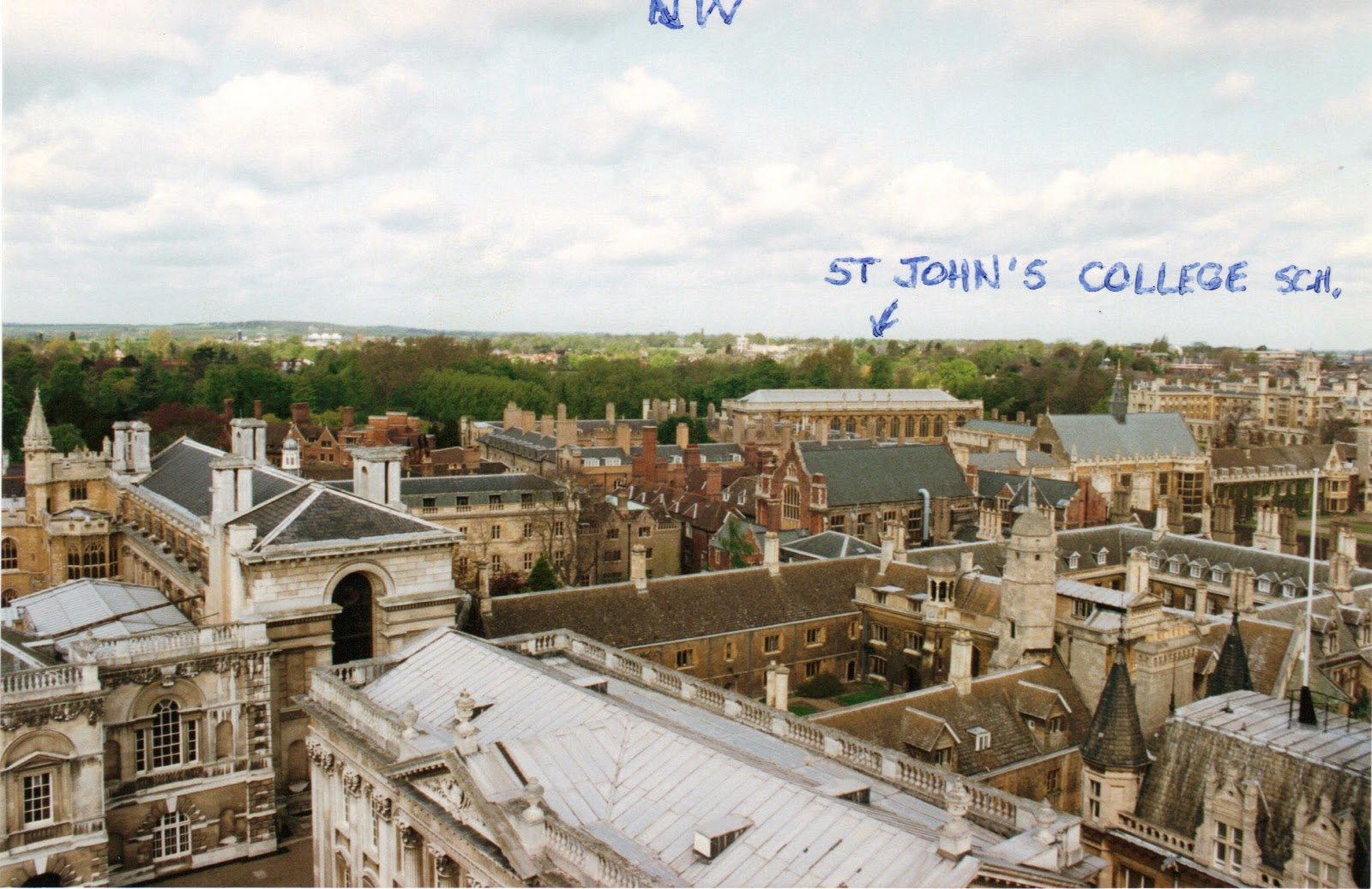
Views From On-High in Cambridge

Thursday, December 8, 2011

17. Spring!

Easter Monday.  20 April.  6:53 a.m.  Back home in Saffron Walden.  Peter's birthday.  A. Hitler's birthday.  Don't know whether it was the chocolate, the lamb, the red wine, the coffee, the temperature or the customs book I read last night, but I tossed and turned.  Perhaps it's just spring time.  Thinking in the last couple of days how I can come to see time not as an enemy but as something that brings me closer to God: it is only through time that I can achieve my purpose.

 Thursday 23 April.  8:25 a.m.  Collette's advice to George Simenon, his credo:

 Keep it short.
Make it readable in one afternoon or evening.
Make the reader want more.

1:45 p.m.  Too many letters to the moon!

2:10 p.m.  Seasons here seemed to have split into two six month periods, with cold, dark days beginning in the end of October and the warm, long days with us now in the end of April.  The tulips are absolutely lovely now, especially our own: bright red, with a touch of orange and a texture that is a cross between velvet and plastic.

Thomas, Me and the Tulips in April

Thomas is very disappointed now when he hears, as he has this week, that there is no school.  Next week.  So many whys!  Mara, whose name, I forgot, means bitter (from the Book of Ruth) also has many, many whys.

6 p.m.  It is hard to know how much of the new country one should put on, and how much of one's own to keep.  "When in Rome" the expression goes, "do as the Romans," not "be."  But that is a fine line sometimes.

Why is it that a smell?
And so we planted sycamores
In our yard to bring us back
To places foreign and near
From time to time.

Friday 24 April.  To London, 10:35 a.m.  Oh the yellow fields of rape!  Trees rapidly filling.

The Rape!!
Live happily, live hidden.  French maxim (from days of the guillotine and the French Revolution?).

Notes on the train ride home:

The Times.
The Guardian.  ("I'm a Guardian reader.")
The tabloids: The Sun, The Mirror, Daily Express, Daily Mail.
Walking in the rain today.
Picadilly, different faces, picture poses, French school children with back packs (in Munich: Canadian 17/18 year olds; in Firenze: Spanish 15 year olds).
More rape, white blooms.
Earrings.
Wise cracking, Cockney accents.
Heyworth: Jesuit college, Cavendish Square.
Beggars and bums, old ladies, tramps.
 
The last time I was on this train, the morning of March 24th, poor woman who left her bags to get a cup of coffee, was gone too long, girls called BR officials and took off the "unattended" bags.  What a surprise when she returned!

Lot of lagoons lately.  What happened to all the Canadian geese at Audley End?  Did someone bag them in the dark of winter?

Surprising how the water flows north through Cambridge.

London poems on the Underground, standing up, leaning with the train.

Wednesday, December 7, 2011

16. Letter to Fr. Forrester

21 April 1992

 Dear Father Forrester,

 Thank you very much for introducing us to Mrs. Bartoli!  She took care of everything, from the pensione to the Vatican Gardens to the Papal Audience on April 1.

 Our year abroad has been wonderful.  In fact, I find myself a bit melancholy at the thought of returning to the mass of confusion back home. . ..

 Over the last few days, the papers have been full of talk about the BBC TV show airing the lack of belief in the Resurrection by many Church of England.  One bishop says get out of the church if you don't believe.  The major papers carry editorials on the subject of Easter and the Resurrection.  The Archbishop of Canterbury tries his own countermeasures.  There is usually something in the news about the state church.  Ironically, the US is also recently in the news as having the highest proportion of people who believe in God and attend church regularly.  It is hard to synthesize all the stories into coherence.  Like the ever so polite British drivers who are forever tailgating you and passing you at reckless speeds on lovely country roads: it takes awhile to make sense.  But I keep on trying.  I hope to attend a lecture on Friday by Archbishop Weakland: "Catholic Uneasiness and the Capitalist Enterprise."  The undeniably great thing about being here is our proximity to one of the world's greatest cities, yet we live in the countryside.  It's hard to imagine such a situation in US.  I have especially come to love the churchyards and their graves.  I grew up accustomed to think of the graveyard as a scary place; next to the churches here they seem friendly. 

We attended Sunday mass at the Milano cathedral, as we did in Salzburg on Palm Sunday.  Listening to mass in a foreign language, one can appreciate the some of the ideas behind the stained glass, sculptures and paintings: they give you something to think about even if you don't understand (or, in the old days, couldn't hear) what's being said.  It is nice to be able to use these churches as they were intended.  In the art museum in Munich hangs a Madonna, taken from a Capuchin monastery, which is noted to have a 100 day indulgence, by order of the Papal Nuncio, for those saying an Ave before the picture.  I wonder how many similar pictures now hang in museums out of work!  

Rome remains as beautiful as I remember from 1967, when Jan and I visited you at Santa Susanna, and were shown around Rome by Father (now Msgr.) O'Leary.  All those water fountains and churches everywhere!  Such action in the streets! . . .

Mrs. Bartoli obtained for us a spacious room not far from St. Peter's on Via della Fornaci, which we all shared in comfort.  We had a good visit with her and obeyed her instructions, especially visiting the Vatican Gardens and St. Clemente.  . . . The Palantine was absolutely lovely, but I suppose the favorite was St. Peter's itself and the Pieta.  We studied the Sistine Chapel ceiling, recently restored (the Last Judgement is now covered and being restored) for 30 or 40 minutes.  The place was jammed, but awesome nevertheless, more so, when I caught a glimpse of myself in the mirror the next day or so, and noted that I looked a little like the condemned man in the Last Judgement, with his hand over half his face.

Signora Bartoli took care of all details for the papal audience.  She gave us instructions on what time to go, where to sit, etc.  It reminded me of my father in the "good old days" giving us instructions for attending the show on the Strip.

 . . .

 So we are back again at home.  The weather is warming, and, having not been able to figure out a way to remain here (at least as of the moment), we are starting to prepare for going home in July.  It has been an outstanding year, one that is hard to believe has actually happened.  Mom and Dad will be here for their second visit in a little more than week; my restless father is off to Africa again and will leave mom here while he travels.  We look forward to the company.

 Thank you once again for your advice and contacts.  We all wish you the best and on your feet soon.

 With gratitude and affection,

 Sincerely,

 Cathy and Michael et familia
We All Learned about
Bernini in Roma!

16. Letter Home: Travelogue

Saturday 17 April.  Brugge to Saffron Walden.  P & O Ferry Ostend to Dover, 9 pm.  Drive home.

21 April 1992

Dear Mom and Dad (and by copy as noted),

We arrived home Saturday morning at two in the morning from our spring holiday, doing it right this time: home with three days before school starts again. 

The big news since we returned is the story of the young British woman who seemed to have everything going for her and was murdered in New Orleans last week by a lifelong young criminal needing drug money.  In Germany I happened to see something on TV (in German) about schools in the US.  I couldn't understand the language, but the point wasn't hard to miss, as the school children learned to dive under desks to get out of the line of fire of gun carrying kids.  On Sunday, the Independent newspaper had a piece identifying London as the crime capital of Europe.  I don't necessarily doubt the story's truth (London is, after all, a huge city, though I suspect that British statistics are a bit more reliable than French or Italian); but there still seems to be an enormous gap between crime here and crime in the US.  I'm sure there are lots of explanations and reasons, but the thought of the random brutality in the US that seems to walk about so freely is quite depressing.  The worst part of things is that it is American culture which is taking over the world, not the other way around.  (We were in Salzburg, Austria and Munich, Germany on the Sunday Euro Disney opened up.  There seemed to be nothing else on the news that day and the days before and after.)

Well, to travelogue!

On Saturday the 11th, we were off again to Salzburg: a 450 mile drive.  We had tried for five nights in Munich (Munchen), but only managed four, staying the extra night instead at Salzburg, about 100 miles slightly southeast of Munich.  The drive up was absolutely magnificent, as we headed north out of Italy through a beautiful valley lying in a split between the snow covered mountains.  (One could easily imagine the Germanic tribes attacking through this pass fifteen hundred years ago.)  This was around Trent.  The road rose gradually until at last we reached the mountains of Austria, where, at one point, we rode a bridge across a valley almost as if we were in a gondola going up to the summit. 

Innsbruck looked graceful and pleasant, business-like and comfortable in a long valley at the foot of the mountains with the river Inn on its other side.  We crossed into Germany for awhile, before going back into Austria and arriving in Salzburg at 6 p.m. Saturday night.  The town, and it seems to be little more than that, was quiet.  It is absolutely charming, pushed up against a couple of large outcroppings of rock; atop the steeper one is the oldest remaining fortress in Europe (c. 1077) and atop the other are trees and a monastery.  On Sunday, we happened into Palm Sunday 11:30 mass at the cathedral (again looking at the art work while listening to mass in a foreign language); we took the funicular up to the fortress afterwards.  It was our prettiest day of the trip, and Salzburg the most picturesque of our stops, not just because of the city, but the Alps in the background, all rugged and snow covered.  The green countryside could not fail to impress anyone.  Visits to the Mozart museum and Mozart birthplace were obligatory, as were various flavors of pretzel and a hot dog, before we set off to Munich.

Hit Munich Sunday night.  Once again a nice room with TV, but nothing in English.  Monday we did the walking tour of downtown, in the light rain, again stopping at the churches:  the one with Fr. Mayer's grave, (Fr. Mayer being the Jesuit who spoke out against Hitler and who is in the process of being canonized), St. Michael's and St. Peter's.  But we also had bratwurst, sauerkraut and beer, and managed to find in Munich our restaurant of the year: Pizza Hut (to go along with the one in Cambridge, and other places on our journeys). I sampled the local brew, a cloudy, clove tasting beer called Weiss beer.  Cathy and I spent several hours in the Alte Pinakothek, the art museum with the standard treasure trove of works, which here are particularly early German painters and Albert Druer.  We learned that Germany's art history is largely influenced by the country's location between the Renaissance of Italian art and the realism of Dutch art. 

On Wednesday Robert, Cathy and I had the sobering experience of visiting the model Nazi concentration camp (KZ) at Dachau.  It is hard to describe the feeling of walking around there.  It was a cold, windy, wet day.  The museum and grounds have mostly an informative, historical aspect to them (the museum with its description of the rise of Nazis and the reasons, the statistics), but it is, of course, the human suffering which makes the greatest impact.  One picture can do more than all the writing; the gas chambers were not actually used at Dachau, but they are there and one can stand inside them, next to the crematorium.  I like to think it was a good lesson for Robert, but even he might be too young to understand.  What I thought of was the amazing evil of the Nazis: through the use of lies and euphemisms and double talk one can make the most horrific things sound banal and mundane; it is a scary side of law and politics, and a powerful argument for the importance of truth at all costs.

Munich did have its brighter sides: the Hofbrau with its beer only by the liter, the colors of the glockenspiel and town towers, the BMW factory and Olympic park; Thomas and his ongoing study of life.  The town itself even looks relatively new, remembering that much has been rebuilt since 1945.  (Cathy said some of it reminded her of UNLV!)

Thursday we had an early start and did nothing but drive: 550 miles to Brugge in Belgium, along the way passing through a new snowfall in the hills, several traffic jams, the beginnings of the Danube (which flows to the Black Sea!), the Rhine, Luxembourg on a hilltop, and a glimpse of the Atomium off in the distance in Brussels, as we took the ring road around the city proper.  Friday we slept in, but drove into Brugge for lunch, a walk around town and a boat ride on the canals.  Brugge is the "Venice of the north."  Having seen them both, one can appreciate the comparison, but it is hard to compare Venice with anything else.  Of course we bought Belgian chocolates and had a waffle.  On our last stop, we visited the Church of Our Lady in time to see the Michelangelo madonna, while a choir finished off its lovely Good Friday hymn and the candles were all extinguished in the church, in respect, we assumed, of the occasion of the death of Jesus.

We had a smooth crossing back from Ostend at 9 pm, gaining an hour on the four hour crossing as we returned to England.  Nothing eventful on the crossing except for some creaks which sounded funny; one also has a tendency to be a bit concerned with all those seasick bag dispensers at every turn throughout the ship.  (And how does it carry all those busses and trucks?)

Thus our holiday.

There have been so many other goings on, it's hard to remember.  I attended a poetry class in the Lake District (one of the prettiest spots in England with magnificent mountains and lakes) and learned about S. T. Coleridge over a weekend.  Mostly retired people, but all with a love for poetry, and teachers who could rattle off a line of poetry at the drop of a hat.  Lovely setting in an old manor house, and a good class.  Stopped by Wordsworth's houses: what gardens and views!  A few days later Cathy and I attended the black tie Times Literary Dinner in London.  Famous writers, a nice reminiscence by William Trevor as writer of the year, nice conversation at the table (no one famous at our table, just book lovers).  We will do the same, attend a black tie literary debate on May 8th in London, between John Mortimer and P.D. James about whether detective fiction is better than serious fiction.  (I think this is a smaller group, we won a ticket in a lottery.)  All these things seem to be available here, so close, so in reach; that's one of the very nice things about England.  We are an hour away from one of the major cities in the world, and yet live basically out in the country.

We missed the election while we were gone.  The Conservatives (John Major) won again.  They have a great system here, only about a month of real campaigning, but most of the stories were about the polls, all saying Labour would win.  If nothing else, it was good to see the people prove  the opinion polls for nought, a bit like Truman in '48.  I think it really boiled down to a few things: a lot of people didn't like the Labour leader, Kinnock, who is retiring now, having lost three elections; people sort of trust Major (or perhaps, better the devil you know...), though he is a bit boring; plus Labour was going to bump up taxes for a lot of people.  Conservatives seem to be a lot like Republicans, but there are differences, beginning with the premise that there already exists national health, rails, etc.  Conservatives are also "greener" than Bush, though that's not saying much!

Last note:  the roads in France and Germany are terrific, Italy not that bad; all of them better than England, and what fun to drive on the right hand side again, though a guy honked at me in France after I made a left turn and drove for a bit on the left!  Gas here is about 45p per liter, that is about $3 a gallon.  In Italy they seem to have a better idea: instead of taxing the hell out of sin, cigarettes and booze, they tax the gas and roads and keep the sin items cheap.  (That must be why the cars are so small.)  It cost about $35 in tolls between Milan and Rome (tolls are also high in France); gas in Italy is about $4.50 a gallon.  Even the VW seems like a Suburban!

Will see you shortly!

Love,

Michael et al

P.S.  How can I ever forget the scene in St. Peter's, Saturday morning, the day we left.  I walked over at about eight in the morning, and there must have been ten or more masses going at the side altars; most being said by priests all by themselves.  In the arms of the cross, with three altars at the end (a cul de sac of altars), masses going on next to each other.  Some in Latin, some in Italian; old style, new style.  Each priest with an altar boy.  The main altars with several nuns in attendance.  When one mass is over, another begins, priests on their way to altars like airplanes at an airport, each with a slot for take off time.  Some masses concelebrated.  Voices echoing through the grates from mass below.  I finally picked a mass that was just starting and the five of us (perhaps the brother or sister of the priest and spouse, nun, a man and myself) stood at the rail for mass in Italian.  Wow!

Ready to Head Home on the Ferry

Monday, December 5, 2011

16. Dachau; Brugges; Good Friday

Wednesday 15 April.  Munchen.  Notes:

Italy and Germany: where poplar trees were meant to grow.

Germany is weeks behind spring's advance in Italy.  Daffodils just coming up here.  It must be two or three weeks behind even England.

Thomas: "If you break the law I will put you in jail."

Finished reading the Passion narratives Tuesday.

Dachau today.  Munchen in Bavaria (Bayerische), colorful and new. 

Early German art to Dürer yesterday at Alte Pinakothek, history of art from religious objects to art for people, big saints, big people.  Netherlands realism vs. Renaissance in Italy.  Do they meet in Germany?

Hotel room: hundred yards or so from station.  Outside room is neon hotel light across the street, just like the movies.

"Moonlighting" on TV in German, before was "Three Musketeers" and "Odd Couple."

Raymond Mayer, Jesuit who spoke out against Hitler.


210,000 dead at Dachau.  30,000 prisoners liberated.  Robert had a lot of questions!

Thought today: I try to be too much like Christ and not enough like myself.  That's why I'm always trying to pray for everyone, trying to solve the problems of violence in the world, wishing for a global solution.  I can't forgive everyone, I can't pray for everyone, it's not possible.  Christ can.  Perhaps I can work on asking him to pray for me and forgive me.  He knows everyone's needs, I do not.  But try to work on understanding his forgiveness, as well as his power.  (It is his, not mine.)

 German hard to understand, though perhaps I am just used to seeing and hearing French (and romance) so often over the years, never German.

 Love those 20 letter long German words!

 Painful, but constructive financial chat with Cathy last night.  Progress!

 Friday 16 April, Good Friday.  Munchen to Brugge, Belgium.  Hotel: Brugge Zuid Novotel, Chartreuseweg 20.8200, Sint-Michiels, Brugge. 

 Good Friday.  17 April.  10:15 a.m. Novotel, Brugge, Belgium.  Thomas and I are in the room.  Everyone else is eating breakfast downstairs.

 Thought: Jesus says, "Come to me all who are weary and want rest."  I never thought of myself as needing or wanting rest, but I see now, perhaps it is a weariness from mental and spiritual anguish as much as physical.

The idea occurred to me the other day that a lawyer such as myself is engaged in the modern equivalent of the shoe maker or factory worker of prior generations.  I am engaged in an intellectual service industry which is now more of a bureaucracy (commercial) than a champion of justice.  I am a day laborer in the garden, nothing special.  I pay the price not so much in physical hardship.  I have little of that.  I pay instead in time devoted to my work.  All of this is simply by way of saying that, in the late 20th century being a lawyer is nothing special.

But, to the first point, I'm making progress.  I think I can at last see how I do need the peace of Christ.

I was thinking just before I opened this book how tomorrow or Sunday or Monday I'll open all the mail and plug my computer back in, balance the check book and become familiar with my keyboard once again.  I will have grown out of practice; and how, looking at the trees, nature, my relationship with simple nature, is the only thing I keep up day by day (together, I hope, with my relationship with Christ; but that is a more evolving relationship). 

Noted: I think I've come to see how to have a personal relationship with Christ.